Training guide / 02 · Precision rifle
Rifle
dry-fire training.
A repeatable routine begins with preparation. Make room for comfort, concentration and honest review in your precision rifle practice.
Start with safe preparationGive consistency a clear definition.
Rifle dry-fire training lets you rehearse a familiar sport-training process without firing a projectile. In 10m air rifle training, that may mean paying attention to the way you prepare and return to a coach-approved routine, rather than adding another scored series.
Define consistency in terms you can actually observe: did you follow your preparation sequence, keep the same focus and take a break when concentration slipped? A session is easier to review when it asks one question.
Dry fire does not measure your hold, prove improved accuracy or reproduce every demand of live shooting. Rifle stability training benefits from qualified observation; a repetition counter cannot diagnose your position or decide whether it is suitable for you.
Confirm that your rifle is suitable.
“Unloaded” does not mean “approved for dry fire.”
Read the manufacturer’s instructions for your exact rifle and any training device. A match air rifle may have a dedicated dry-fire setting; that does not make the same procedure suitable for other air rifles or cartridge rifles. The Feinwerkbau manual library illustrates why model-specific instructions matter.
Have a qualified instructor teach and verify the unloading and training-mode procedure. Remove pellets and live ammunition from the practice area, maintain a verified safe direction and suitable backstop, and keep your finger outside the trigger guard except during the authorized rehearsal. Control access to the area and stop if interrupted.
Follow your club’s handling rules and the manufacturer’s instructions for cylinders, accessories and safe storage. Do not improvise mechanical modifications or use an app cue to override a range command. If you cannot establish a safe setting, postpone the session.
Prepare. Settle. Pay attention.
Make preparation repeatable.
Use the sequence taught by your coach to prepare yourself and your equipment. Keep an agreed equipment configuration stable during a practice block so that the session has a clear reference point. This guide does not prescribe stock adjustments or a shooting position.
Respect comfort and stability.
A useful session should not become a contest to endure discomfort or hold the rifle for longer. Rehearse within a comfortable workload, with regular safe rests. If you notice strain, stop and ask your coach to review the setup. Do not force your body to match a generic position diagram.
Give visual attention one job.
Choose a familiar visual or concentration cue with your coach before you begin. Keep the task consistent across a small set of rehearsals. If the view becomes unclear or concentration fades, reset safely rather than extending a repetition indefinitely.
The goal is a repeatable preparation routine with room to notice your experience. It is not a claim that every rehearsal will be perfectly still.
A considered rifle practice structure.
An illustrative 12-minute planning example, not a prescribed workload or an in-app custom program. Allow longer for safety checks and rest; stop sooner if needed.
-
03 min
Prepare without rushing.
Check the equipment and practice area. Choose one preparation or concentration cue already agreed with your coach.
-
03 min
Rehearse your familiar routine.
Complete a small number of deliberate repetitions, allowing a full safe reset between them. Stop before comfort or attention deteriorates.
-
02 min
Rest and take stock.
Secure the rifle as instructed. Ask whether you are still practising the same process rather than simply accumulating repetitions.
-
03 min
Return to the same cue.
Repeat a short block only if you feel ready. Keep the focus and setup consistent so the two blocks can be discussed meaningfully.
-
01 min
Record and close.
Finish the safety routine and record a session rating. Put a specific observation or question in your separate training journal.
Track a routine over time.
Use a simple weekly review: which sessions did you complete, what did you focus on and where did you stop or need a reset? Compare like with like. A short concentration session and a longer supervised range session serve different purposes.
Example journal entry · Illustrative
“Focus: consistent preparation. The first block felt unhurried; I became distracted in the second. Next time: keep the same cue and discuss session length with my coach.”
Keep those notes in a separate journal. In the app, use session history, repetitions and your own ratings as an activity record. A streak can help you notice a habit; it should never persuade you to practise when conditions, comfort or attention are unsuitable.
A rifle training app for the routine.
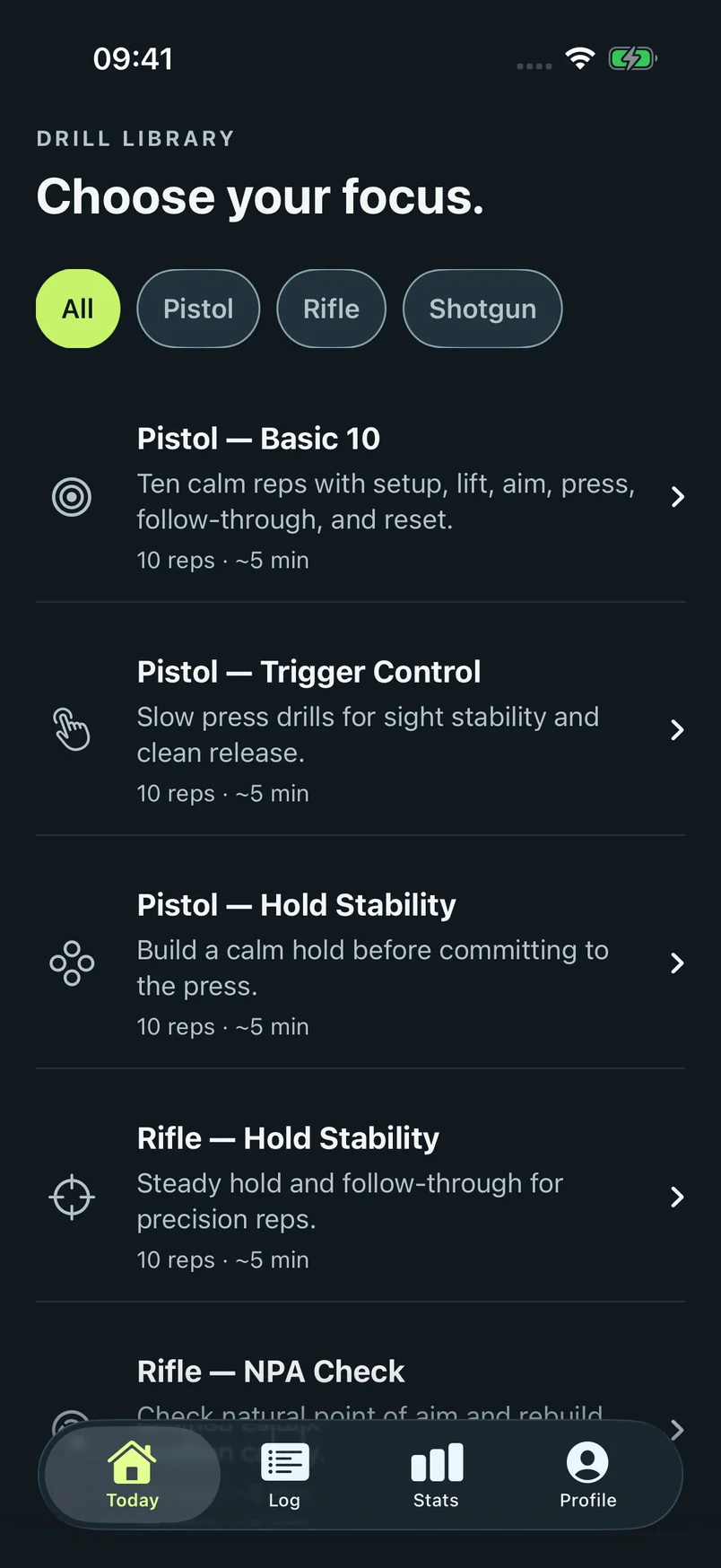
Dry Fire Practice is an iPhone app for guided sport practice. Choose a Rifle drill such as Rifle — Hold Stability, complete your safety checks, then follow the process cues. Tap Rep done after a completed repetition. At the end, record your own session rating and review the session in Log.
Manual practice, basic statistics, streaks and the seven most recent sessions are free. Pro adds full history, advanced statistics, voice cues, repetition timing details and optional microphone click detection.
The app records practice activity. It does not measure stability, aiming movement, accuracy or target scores, and a rating is your assessment, not a technical diagnosis.
Explore the app, read how session history works or check the privacy policy. The App Store lists current availability and compatibility.
Keep the practice useful.
- Using duration as a stability score.
- A long rehearsal is not evidence of a good position. Let qualified feedback, comfort and the purpose of the session guide the workload.
- Adjusting equipment after every repetition.
- Frequent changes make it harder to understand what you are practising. Discuss setup changes with your coach and separate them from a focused rehearsal block.
- Skipping the reset.
- A repeatable start matters as much as the rehearsal itself. Make time to prepare again rather than treating the next repetition as automatic.
- Reading too much into app totals.
- Counts and streaks show recorded activity. They do not measure aiming movement, physical stability or competitive readiness.
Worth knowing
Frequently asked questions
Is this guide specifically for 10m air rifle training?
Its examples are written for deliberate precision-sport practice, including 10m air rifle athletes. They are not a universal training plan for every rifle discipline. Adapt the routine with a qualified coach and follow the instructions for your own equipment.
Can I dry-fire a rifle that has no training mode?
Do not infer compatibility from the absence of a pellet or cartridge. Ask the manufacturer about the exact model and any required accessories before beginning. Instructions for one rifle do not establish that another rifle is suitable.
Can Dry Fire Practice measure rifle stability?
No. The app does not measure movement, aim traces, hold quality or target scores. A drill name describes its practice focus; it is not a sensor measurement. Use qualified coaching and appropriate range feedback to assess technique.
How many repetitions should I complete?
Choose a manageable workload with your coach. The sample above deliberately leaves the count flexible. Stop if attention, comfort or safety is compromised; completing a number or maintaining a streak is never a reason to continue.
Does microphone detection work with every rifle?
No. Pro detection depends on the sound of compatible equipment, phone placement and background noise. Calibrate only within a safe setup and use manual counting if results are unreliable. See microphone support.
Further reading
Use the instructions for your exact equipment and the current rules at your club or event. These independent resources do not endorse this app or these sample sessions.
- Feinwerkbau equipment manualsModel-specific operating and safety instructions for air rifles and pistols.
- ISSF rules and regulationsCheck the current edition and the instructions of event officials.
- CMP safe gun handling guidanceFoundational safety guidance; your manufacturer and local rules also apply.
Written by Dry Fire Practice. The session examples are editorial planning suggestions to discuss with a qualified coach; they are not ISSF programs or individualized coaching.