Training guide / 01 · 10m air pistol
Air pistol
dry-fire training.
Give each repetition a clear purpose. A practical guide to preparation, attention and review for 10m air pistol athletes.
Start with safe preparationPractise the process, not an imagined score.
Air pistol dry-fire training is a way to rehearse an established shooting process without launching a pellet. It creates space to notice whether you prepare consistently, stay with your chosen focus and complete the routine without rushing toward the next repetition.
For a serious precision pistol athlete, a useful session has a question behind it: “Did I complete my preparation each time?” or “Did I keep my attention through the finish?” These questions are more informative than simply reaching a large repetition total.
Dry fire complements coached 10m air pistol training. It cannot show where a pellet would land, reproduce every aspect of a scored series or replace supervised range practice. Use range feedback and your coach’s observations to assess transfer.
Check the equipment. Establish the space.
Compatibility comes first.
Use only the dry-fire method approved for your exact pistol. A dedicated training mode is not the same as firing an empty airgun. Some equipment must not be dry-fired. Check the manufacturer’s manual; if the instructions are unclear, ask the manufacturer or a qualified instructor before proceeding.
- Verify the pistol is unloaded using the procedure you have been taught for that model. Remove pellets and other ammunition from the practice area.
- Keep the muzzle in a verified safe direction with a suitable backstop. Never use people, pets or an ordinary wall as an assumed safe target.
- Keep your finger outside the trigger guard except during an authorized rehearsal. Prevent interruptions and unauthorized access.
- After an interruption, stop and re-establish all safety checks. Finish by securing the equipment according to the manual and local rules.
Air pistol practice at home is appropriate only when the location, supervision, equipment and applicable rules allow it. If you cannot establish those conditions, use an authorized club facility. New athletes should first learn safe handling in person.
Build a routine you can repeat.
Choose one focus already agreed with your coach. Keep the session short enough that you can give that focus your full attention. A regular, manageable place in your week is more useful than a plan you repeatedly abandon.
Preparation
Before handling equipment, decide what a satisfactory repetition means today. Use a simple process criterion, such as completing the same preparation sequence. Keep your phone positioned so checking a cue will not compromise safe handling.
Focus and process
Rehearse the familiar sequence your coach has taught you. Give attention to one agreed cue instead of monitoring several technical changes at once. If attention wanders, pause and reset; a hurried repetition need not be rescued just to keep the count moving.
Follow-through and reset
Give the finish of the rehearsal the same attention as the beginning. Complete your coach-approved follow-through, then reset safely before recording the repetition. The purpose is to notice consistency, not to invent a score from how a rehearsal felt.
A short air pistol practice session.
An illustrative 10-minute planning example, not a prescribed workload or an in-app custom program. Allow longer for safety checks and rest; stop sooner if needed.
-
02 min
Prepare and choose a focus.
Complete the safety routine without rushing. Name one process cue and decide when you will stop.
-
03 min
Rehearse a small block.
Work through a few familiar repetitions at your own pace. Notice whether you give preparation and follow-through equal attention.
-
01 min
Pause and reset.
Rest safely and check concentration and comfort. Continue only if you can maintain the same deliberate process.
-
03 min
Repeat the same focus.
Use a second short block to revisit the same cue. Avoid introducing an equipment adjustment or a new technical goal midway through.
-
01 min
Review and finish safely.
Secure the equipment. Record your session assessment and one question to take to your next coached practice.
Make quality visible in your review.
After a session, separate what happened from what you think it means. The number of repetitions tells you how much practice you recorded. Your own rating describes your experience of the process. Neither is a target score.
Example journal entry · Illustrative
“Focus: complete the same preparation. I rushed after a distraction, then paused and restarted. Next session: keep the reset unhurried.”
Keep detailed observations in a separate training journal or your coach’s preferred record. Dry Fire Practice stores session ratings and repetitions; it does not provide a free-text coaching journal. At a weekly review, compare similar sessions and discuss recurring difficulties rather than judging a single day.
How Dry Fire Practice supports pistol athletes.
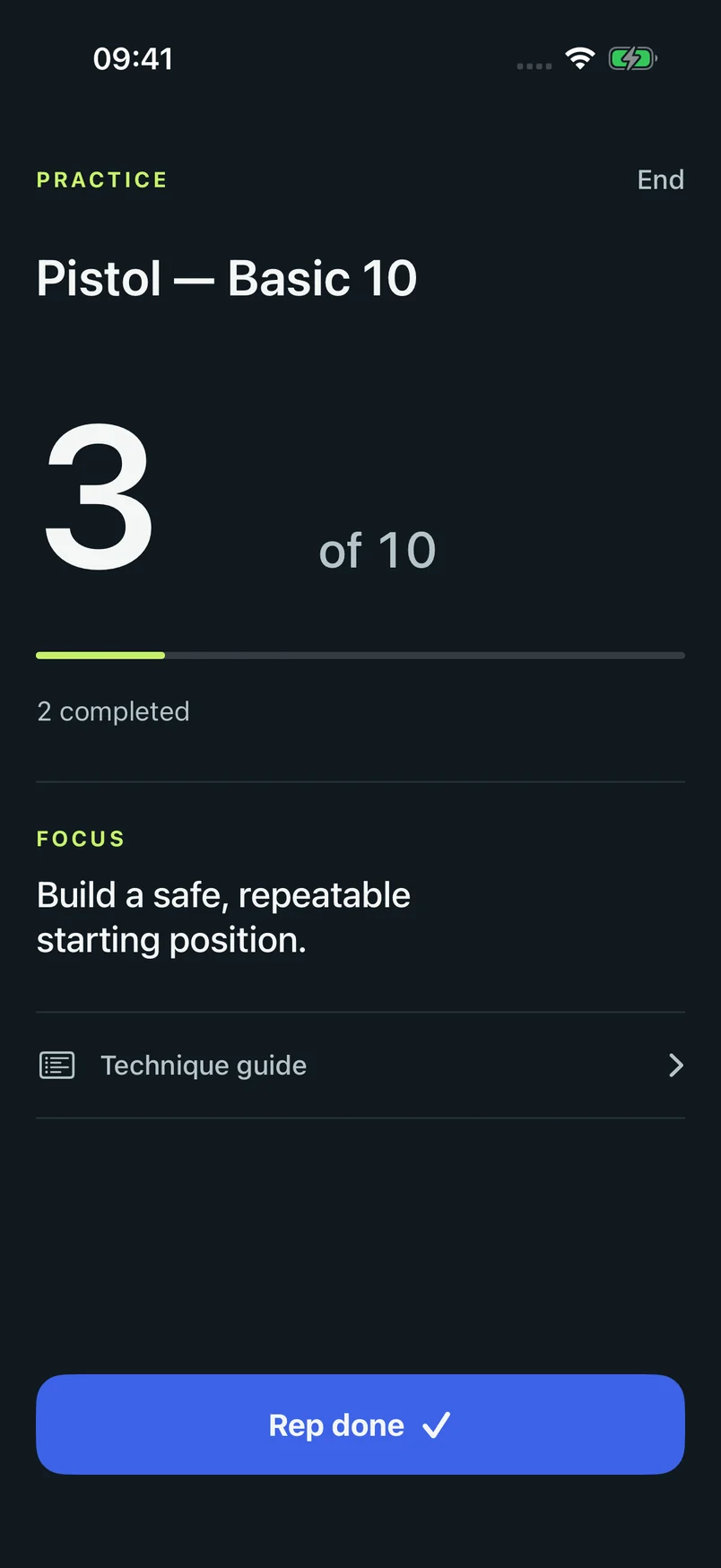
Dry Fire Practice is an iPhone app for guided sport practice. Choose a Pistol drill such as Pistol — Basic 10, complete your safety checks, then follow the process cues. Tap Rep done after a completed repetition. At the end, record your own session rating and review the session in Log.
Manual practice, basic statistics, streaks and the seven most recent sessions are free. Pro adds full history, advanced statistics, voice cues, repetition timing details and optional microphone click detection.
The app records practice activity. It does not measure stability, aiming movement, accuracy or target scores, and a rating is your assessment, not a technical diagnosis.
Explore the app, read how session history works or check the privacy policy. The App Store lists current availability and compatibility.
Common mistakes to catch early.
- Chasing the count.
- Finishing a number can become the goal. Keep the quality of the process as the reason for each repetition, and stop when that quality is no longer sustainable.
- Changing too many things.
- A different cue every few repetitions makes review difficult. Choose one focus with your coach and keep equipment changes separate from the session.
- Training through fatigue.
- Discomfort or fading attention is a reason to pause, not a test of commitment. Reduce the workload and discuss recurring discomfort with an appropriate professional.
- Assuming a quiet room is a safe room.
- Compatibility, safe direction, unloading checks and access control still matter. Reassess the setting every time.
Worth knowing
Frequently asked questions
Is dry-fire practice useful for ISSF air pistol athletes?
It can provide time to rehearse an established preparation and attention routine. Use it alongside qualified coaching and supervised range practice. For ISSF air pistol practice at an event, follow the current ISSF rules and officials’ directions about permitted times and areas; this guide is not an ISSF training program.
Can every air pistol be dry-fired?
No. Compatibility and the correct training mode depend on the model. Do not assume that removing a pellet makes a normal firing cycle suitable for repeated dry fire. Follow the exact manufacturer instructions and seek clarification if needed.
How long should a pistol training routine be?
There is no universal duration or repetition target. The ten-minute example above is a planning aid, including preparation and review. Your experience, comfort, supervision and coach’s plan should determine the actual workload.
Can the app tell whether my aim improved?
No. It does not track aiming movement, evaluate a sight picture or score a target. Session ratings are self-reported. Discuss technical progress with your coach and evaluate shooting outcomes in appropriate range practice.
Do I need microphone click detection?
No. Manual repetition counting is free. Optional Pro detection can count supported clicks, but equipment and background noise affect results. A detected sound is not a judgment of technique. Read the click detection guidance.
Further reading
Use the instructions for your exact equipment and the current rules at your club or event. These independent resources do not endorse this app or these sample sessions.
- Steyr Sport air pistol manualsManufacturer instructions; select the exact model and revision.
- ISSF rules and regulationsCheck the current edition and the instructions of event officials.
- CMP safe gun handling guidanceFoundational safety guidance; your manufacturer and local rules also apply.
Written by Dry Fire Practice. The session examples are editorial planning suggestions to discuss with a qualified coach; they are not ISSF programs or individualized coaching.