Training guide / 03 · Start here
Dry-fire training
for beginners.
Understand the practice before you begin. A beginner’s guide to safe preparation, simple routines and knowing what a session can tell you.
Start with safe preparationWhat is dry-fire practice?
Dry-fire practice is a rehearsal of an established shooting process without firing a projectile. Depending on the equipment, it can involve an unloaded firearm or a manufacturer-approved training mode on an airgun. It does not mean firing an airgun normally with no pellet, and it is not appropriate for every model.
In precision sport, the useful starting point is a familiar sequence taught by an instructor: prepare, pay attention to one cue, complete the rehearsal and reset safely. You can begin learning the sequence and planning a session without handling equipment at all.
This guide is for beginners in sport shooting. It is not a substitute for qualified instruction, manufacturer guidance or supervised range practice. If safe handling is new to you, your first practical session belongs with a qualified instructor.
Before any equipment is handled.
Do not begin an equipment-based dry-fire session until an instructor has taught you the relevant procedures and confirmed that you can use them safely. Young athletes need appropriate responsible adult supervision and must follow their club’s requirements.
- Confirm compatibility. Read the exact model’s manual. Ask the manufacturer if dry firing is permitted and whether a dedicated mode or approved accessory is required. Do not guess or improvise.
- Verify the unloaded condition. Use the manufacturer’s procedure, as taught by your instructor. Keep pellets, live ammunition and loaded magazines out of the practice area.
- Establish a safe direction. Use a controlled location and a suitable backstop. Never assume an ordinary wall will contain a projectile. Never point equipment at people or pets.
- Control access and attention. Keep others from entering the practice area. Keep your finger outside the trigger guard except during the authorized rehearsal. Stop when distracted or interrupted.
- Plan a safe finish. Recheck after interruptions, and secure equipment when the session ends. Follow local, club and range rules throughout.
These are planning reminders, not an unloading procedure or a complete safety course. Read CMP’s foundational safety guidance alongside your manufacturer’s instructions. An app cannot verify an unloaded condition, a backstop or safe handling.
What dry fire can—and cannot—offer.
Time to rehearse.
A familiar preparation sequence, attention to a coach-approved cue, a deliberate finish and the habit of reflecting on practice. You can work on the organization of a session without needing a scored target.
Limits to respect.
No evidence of where a projectile would land, no complete recreation of live shooting and no automatic diagnosis of technique. Repeating a mistake can make it familiar, so regular qualified feedback still matters.
Think of dry-fire exercises as one part of learning. Qualified instruction explains what to practise; supervised range work helps you assess shooting outcomes. A log shows the work you recorded, not a guaranteed improvement.
Start with one familiar task.
First, practise planning.
Without handling equipment, describe the safety checks, the focus of the session and how you will finish. If you cannot explain a step, ask your instructor before continuing. This is a useful first exercise in its own right.
Then rehearse what you have been taught.
Once your instructor has confirmed the setup and your readiness, use a short, familiar routine. Choose one process cue, such as completing the preparation sequence before each repetition. Do not add speed, unfamiliar techniques or a large target count.
Make room to stop.
Rest between small blocks. Stop for uncertainty, discomfort, fatigue or distraction. A deliberate pause is a good decision, even when a practice plan or an app still has repetitions remaining.
Your first short session, with guidance.
An illustrative 8-minute planning example, not a prescribed workload or an in-app custom program. Allow longer for safety checks and rest; stop sooner if needed.
-
03 min
Prepare with your instructor.
Verify compatibility and complete the safety checks. Agree on one familiar task. Take longer here whenever you need it.
-
02 min
Rehearse a few repetitions.
Follow the sequence you have already learned, at a comfortable pace. Give preparation and a safe reset time of their own.
-
01 min
Pause and ask.
Rest safely. Tell your instructor what felt clear and what did not. Do not continue while uncertain about a procedure.
-
01 min
Revisit the same task.
If the instructor agrees you are ready, try a small additional block. There is no minimum count to prove you have practised properly.
-
01 min
Close and review.
Finish and secure the equipment. Record what you practised and choose one question for your next lesson.
Using a dry-fire training app.
Dry Fire Practice is an iPhone app for guided sport practice. Choose a Pistol drill such as Pistol — Basic 10, complete your safety checks, then follow the process cues. Tap Rep done after a completed repetition. At the end, record your own session rating and review the session in Log.
Manual practice, basic statistics, streaks and the seven most recent sessions are free. Pro adds full history, advanced statistics, voice cues, repetition timing details and optional microphone click detection.
The app records practice activity. It does not measure stability, aiming movement, accuracy or target scores, and a rating is your assessment, not a technical diagnosis.
Explore the app, read how session history works or check the privacy policy. The App Store lists current availability and compatibility.
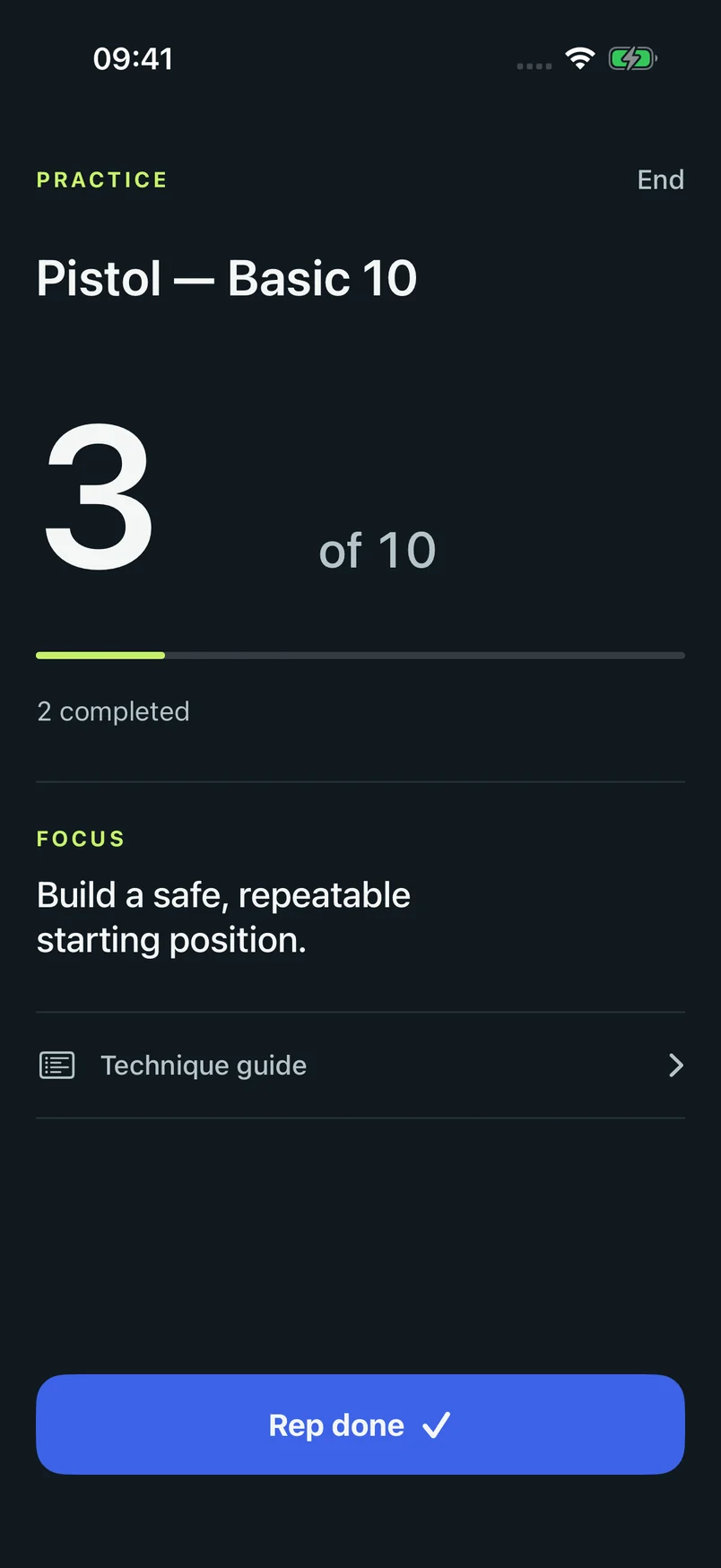
Choose a drill appropriate to your discipline and instructor’s plan; rifle athletes can select Rifle in the library. The examples in this article are suggested session structures, not extra programs built into the app.
Manual practice or microphone detection?
Manual is a good starting point.
Count completed repetitions with Rep done. Manual counting is free, needs no microphone permission and lets you become familiar with the guided process before adding another tool.
Detection is optional.
Pro microphone detection can count supported dry-fire clicks. Equipment, phone placement and background noise affect results. Calibrate for your safe setup, and return to manual counting if clicks are missed or counted incorrectly.
Neither method measures accuracy, aiming movement or the quality of a repetition. A sound being detected does not mean a rehearsal was correct or safe. Audio is processed on your iPhone; see click detection support and the privacy policy.
Review the session without judging a score.
Record the drill, completed repetitions and your own session assessment. Ask a simple question: “Did I follow the agreed routine?” A second useful question is: “What do I need to ask my instructor?”
Example journal entry · Illustrative
“I completed a short guided session. I needed a reminder to pause after a distraction. Next lesson: review my preparation checklist.”
Use a separate notebook or your coach’s preferred journal for written observations; the app’s session rating is not a free-text note. Review a few sessions together to notice your habits, without treating repetition totals or streaks as a qualification to practise unsupervised.
Common beginner mistakes.
- Starting before checking the manual.
- An online exercise cannot establish equipment compatibility. Confirm the exact model’s requirements before any trigger rehearsal.
- Learning handling from an app alone.
- Text cues cannot check your setup or intervene. Get in-person instruction and appropriate supervision first.
- Trying to do too much.
- Choose one familiar task. More repetitions, speed or complex exercises do not make a beginner session more useful.
- Confusing a count with progress.
- Review your process with an instructor. Keep target scores, technical feedback and app activity records distinct.
Worth knowing
Frequently asked questions
Can I start without a firearm or airgun?
Yes. Begin by learning the safety requirements, reading the appropriate manual and planning a session with an instructor. You can review the app’s guidance without handling equipment. Equipment-based rehearsal comes only after compatibility, safe conditions and readiness have been established.
How can I practise dry fire safely at home?
A home setting is not automatically suitable. Have a qualified instructor help you establish safe handling, equipment compatibility, a controlled area, a safe direction and suitable backstop. Follow the manufacturer and applicable local rules. If any condition is uncertain, use an authorized supervised facility instead.
Will dry-fire training improve my scores?
It can give you time to rehearse a familiar process, but improved scores are not guaranteed. Dry fire does not replace qualified coaching or supervised range practice, where shooting outcomes can be evaluated.
Which guide should I read after this one?
Choose the air pistol training guide or the rifle practice guide for your discipline. Discuss the suggested routine with your instructor before adapting it.
Do I need to buy Pro to begin?
No. Guided manual practice, basic statistics, streaks and the seven most recent sessions are free. Pro is an optional one-time purchase for additional features. See free and Pro features and the App Store for the current local price.
Further reading
Use the instructions for your exact equipment and the current rules at your club or event. These independent resources do not endorse this app or these sample sessions.
- CMP safe gun handling guidanceFoundational safety guidance; your manufacturer and local rules also apply.
- Steyr Sport air pistol manualsManufacturer instructions; select the exact model and revision.
- Feinwerkbau equipment manualsModel-specific operating and safety instructions for air rifles and pistols.
Written by Dry Fire Practice. The session examples are editorial planning suggestions to discuss with a qualified coach; they are not ISSF programs or individualized coaching.